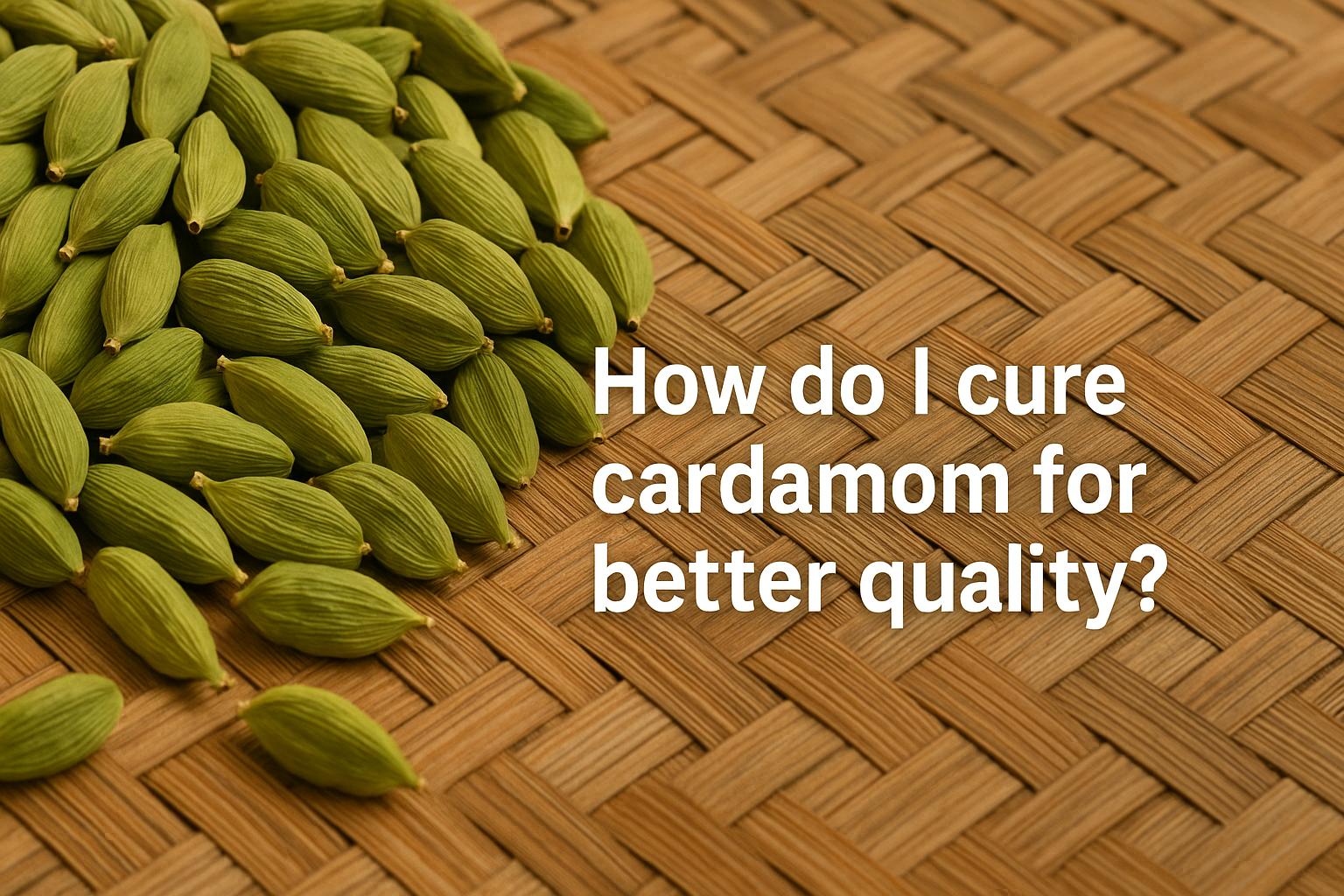
How do I cure cardamom for better quality?
To cure cardamom for better quality, harvest mature green pods and begin drying within 12 hours to prevent mold. Use a combination of shade pre-drying and controlled heat drying at 45–50°C to preserve aroma, color, and essential oils. Spread pods thinly on raised trays, ensure good airflow, and monitor moisture to reach an ideal 8–10% content. Avoid overheating, overexposure to sunlight, and excess humidity. After curing, store in airtight, moisture-proof containers at 20–25°C with low humidity. Proper curing enhances color retention, aroma strength, oil concentration, and market value.
What are the steps in the traditional cardamom curing process?
Traditional curing is a time-tested method that ensures flavor, color, and aroma are preserved without artificial additives or chemical intervention.
- Harvesting at the right maturity
Cardamom should be harvested when the pods are fully mature but still green. Harvesting immature pods results in poor flavor and shriveled seeds, while overripe pods split open and lose essential oils. - Cleaning and sorting before curing
After harvest, the pods are manually cleaned to remove stalks, dirt, and unripe or split capsules. Sorting ensures that only healthy, intact pods go through the curing process, which improves final product consistency. - Pre-drying under shade
The pods are pre-dried in partial shade for a few hours to reduce surface moisture. This step helps prevent microbial activity and avoids the risk of pod fermentation during later curing stages. - Sun drying with regular turning
Pods are spread thinly over mats or mesh trays and exposed to indirect sunlight. They must be turned every 2 to 3 hours to ensure even drying and to prevent patchy discoloration or fungal buildup on the underside. - Final drying using flue or kiln chambers
Once partially dried, the pods are transferred to a flue-curing chamber or a kiln dryer where warm air circulates between 45–50°C. This controlled environment prevents overheating and preserves essential oils and chlorophyll. - Cooling and conditioning
After drying, the pods are kept in a shaded area to cool down gradually. This prevents condensation and helps the internal moisture stabilize, preparing the pods for final processing. - Grading, polishing, and packing
Cured cardamom is graded by size and color. Polishing is done using mechanical polishers or by rubbing in clean jute sacks to remove surface wrinkles. It is then packed in airtight, moisture-resistant containers for long-term storage or sale.
How long should cardamom be cured for optimal quality?
Curing duration directly impacts the flavor, color, moisture, and shelf life of cardamom pods. The right balance between drying speed and quality retention is essential.
- Sun drying duration varies by weather
In warm, dry climates, sun drying takes about 4–6 days. In humid or cloudy regions, it may stretch to 8 days or more. Prolonged exposure to sun must be avoided to prevent loss of volatile oils and discoloration. - Mechanical drying is faster and uniform
With flue-curing or mechanical dryers, cardamom can be fully cured in 18 to 24 hours. This method is ideal for commercial-scale farmers needing consistency, but temperature must be strictly controlled to avoid oil evaporation. - Multiple-stage curing may be used
Some producers use a hybrid approach: 1–2 days sun drying followed by flue-curing. This technique reduces energy costs while still controlling final quality. - Excessive curing time risks splitting
Over-curing causes pods to become brittle and break open, which reduces commercial value and exposes seeds to contamination. Time must be carefully adjusted based on pod size and moisture. - Under-curing leads to fungal growth
If the pods retain too much moisture after curing, mold can develop during storage. A precise drying schedule and moisture monitoring prevent this issue.
What temperature should I maintain during cardamom drying?
Temperature control is one of the most critical factors in the cardamom curing process. Too much heat damages flavor and color, while too little heat prolongs drying time and increases spoilage risk.
- Start drying at 45°C and do not exceed 50°C
A controlled temperature between 45°C and 50°C is ideal for preserving green color and essential oil content. Exceeding 55°C causes pod browning and loss of volatile aromatic compounds. - Use stepped temperature increase for uniform drying
Starting with 40–42°C and gradually increasing to 48–50°C allows the outer shell and seeds to dry evenly. A sudden increase in temperature can result in hardened outer layers while the seeds inside remain moist. - Avoid direct contact with heat source
Whether using a kiln or flue dryer, cardamom pods should not be placed directly on heated surfaces. Indirect heat ensures uniform exposure and avoids burning. - Use thermal sensors and thermostats
Manual monitoring often leads to inconsistencies. Modern curing systems should have thermal sensors that automatically adjust heat levels to match the drying stage. - Fluctuating temperatures reduce quality
Inconsistent heat leads to uneven curing, resulting in pods of varying moisture content, which affects grading. Uniform heat distribution is critical to maintaining batch quality.
How do I assess when cardamom pods are fully cured?
Determining when cardamom is completely cured requires observation and moisture testing. Underdrying risks spoilage, while over-drying reduces market value.
- Pods become firm and crisp
Properly cured pods feel firm to the touch and produce a crisp snap when broken. They should not feel soft or rubbery, which indicates incomplete drying. - Green surface with light sheen
The outer shell retains a clean green or slightly olive color with a natural sheen, not dull or faded. Loss of color is a sign of overexposure to sun or high temperatures. - Moisture content drops to 8–10%
Use a digital moisture meter to test internal pod moisture. Values above 12% are too wet and risk spoilage, while below 7% makes pods brittle. - Seeds are dark and aromatic
The seeds inside should be black or dark brown with a strong, sweet-spicy aroma. Pale or odorless seeds suggest immature harvest or improper drying. - Pods should be free of mold or internal condensation
Visual inspection of a sample batch helps confirm dryness. Any sign of mold, internal sweating, or musty smell indicates the need for further drying or re-curing.
What is the ideal moisture content for cured cardamom?
Moisture content directly affects shelf life, flavor preservation, and microbial safety of cured cardamom. Precise control is essential for premium quality.
- Target moisture content is 8–10%
This range balances preservation with pod flexibility. It keeps pods firm without making them brittle, and ensures the seeds stay intact without fungal risk. - Above 12% invites microbial growth
Moisture higher than 12% allows mold and bacteria to thrive during storage. This compromises product safety and appearance, especially in humid climates. - Below 7% leads to brittleness
Excessively low moisture makes the pods hard and causes seed separation during handling. This is especially risky during transport where pods may break apart. - Use moisture meters for accuracy
Hand-feel and visual cues are not enough. A digital moisture meter ensures curing is consistent across the entire batch, especially in commercial drying systems. - Monitor during storage, not just curing
Cardamom continues to absorb or release moisture depending on storage conditions. Hygroscopic behavior makes post-curing monitoring just as important to maintain quality.
How does curing method affect cardamom color retention?
The color of cardamom pods is a key quality indicator in both domestic and export markets. The curing method used directly determines how well the natural green pigment is preserved.
- Low-temperature curing preserves chlorophyll
Gentle drying at 45–50°C helps maintain the chlorophyll responsible for the bright green hue of high-quality cardamom. Higher temperatures cause chlorophyll breakdown, leading to yellow or brown discoloration. - Sun drying can fade color without shade control
Open sun drying causes uneven fading due to UV exposure. When shade-net systems or partial canopy drying is used, the pods retain their original color better while still drying effectively. - Flue-curing is best for color preservation
Indirect hot air from flue chambers provides consistent heat without direct sunlight or smoke contact. This method locks in the natural green shade and prevents browning caused by erratic drying. - Sulphur bleaching is sometimes used
Though not preferred by health-conscious markets, sulphur fumigation enhances green color artificially. However, it must follow regulatory limits, as excessive use leads to residue and chemical odor. - Drying time affects pigment breakdown
Rapid drying using controlled heat is better for preserving color than slow drying under fluctuating temperatures. Prolonged exposure, especially in humid environments, causes oxidation and dullness. - Moisture fluctuation post-curing reduces color stability
Improper storage after curing can lead to color changes. If the pods absorb ambient moisture, the surface dulls or darkens. Maintaining low humidity in storage preserves post-curing color integrity.
Can improper curing affect the aroma of cardamom pods?
Aroma is one of cardamom’s most prized qualities, driven by its volatile essential oils. Poor curing practices degrade these oils and diminish the spice’s value.
- High heat evaporates volatile oils
Essential oils like 1,8-cineole and α-terpinyl acetate begin to degrade above 50°C. If pods are cured at excessive temperatures or too quickly, aroma is significantly reduced. - Delayed curing leads to fermentation
If fresh cardamom is left unprocessed for too long, internal fermentation begins. This causes the development of sour or musty smells that overpower the spice’s natural sweetness. - Overexposure to UV light damages aroma
Direct sunlight during drying causes photodegradation of aromatic compounds. Using filtered light or drying indoors prevents this chemical breakdown. - Under-dried pods trap moisture and develop off-odors
Moisture above 12% encourages microbial activity that leads to moldy, stale, or earthy smells. Even small patches of retained moisture in bulk storage compromise overall aroma. - Poor ventilation during curing leads to sour notes
In enclosed or poorly ventilated dryers, stale air accumulates. This results in an unpleasant sour scent in the cured product, especially in high-humidity conditions. - Properly cured pods have strong, sweet, spicy aroma
When done correctly, curing intensifies the cardamom’s natural perfume. The seeds inside remain fragrant and pungent, indicating high-quality oil retention.
Does artificial drying damage essential oil content in cardamom?
Artificial drying methods, when misused, can reduce the potency of essential oils that give cardamom its characteristic flavor and aroma.
- Controlled artificial drying preserves oils
Using flue-curing systems set between 45–50°C ensures that pods dry evenly while preserving essential oils. Rapid, intense drying above this threshold leads to partial or complete oil loss. - Unregulated dryers cause heat stress
When temperature fluctuates or spikes inside the drying chamber, oil compounds escape. This results in low-grade pods with poor aroma and shortened shelf life. - Gentle air circulation enhances oil retention
Dryers with adjustable airflow reduce drying time while preventing overheating. Even airflow removes moisture without causing thermal shock to the oil glands inside the seeds. - Pod layering depth in dryers matters
Overloading dryers or piling pods too thick causes uneven heat distribution. Outer pods dry too fast and lose oil, while inner ones remain damp. Spreading pods in uniform layers ensures consistent quality. - Hybrid methods offer better control
A combination of shade drying followed by short-duration artificial drying preserves both oils and color. This hybrid technique lowers fuel use and minimizes damage. - Sensor-equipped dryers improve outcome
Modern systems with built-in moisture and temperature sensors ensure real-time adjustments, maintaining optimum curing conditions for essential oil preservation.
Can mechanical dryers improve the consistency of curing?
Yes, mechanical dryers offer efficiency and precision that traditional methods often cannot guarantee, especially for large-scale or export-oriented operations.
- Uniform temperature and humidity control
Mechanical dryers distribute heat evenly and maintain constant temperature throughout the drying cycle. This prevents over-drying some pods while under-drying others, which is common in manual systems. - Reduces drying time significantly
Traditional sun drying can take 5–7 days, depending on weather. Mechanical dryers complete the process in just 18–24 hours, improving processing turnaround during peak harvest. - Minimizes labor dependency
Manual turning and monitoring during sun drying require high labor input. Mechanical dryers automate this process, reducing human error and cutting costs in the long term. - Improves batch-to-batch consistency
With flue or chamber dryers, each batch follows the same preset drying protocol. This ensures that every kilogram of cardamom meets similar quality standards, crucial for branding and grading. - Reduces post-harvest spoilage risks
Mechanical drying begins immediately after harvesting, limiting the window for microbial growth. This is vital during wet seasons when natural drying is delayed. - Enables drying during unfavorable weather
In areas with unpredictable rainfall or high humidity, mechanical dryers allow uninterrupted curing. This guarantees continuous production regardless of external conditions.
Is solar drying effective for preserving cardamom quality?
Solar drying, when done correctly, is an effective low-cost method for small to medium-scale growers looking to maintain product quality without chemical treatments.
- Cost-effective and energy-efficient
Solar drying requires no fuel and minimal infrastructure, making it ideal for low-income or remote farming areas. Properly constructed solar dryers use greenhouse principles to trap heat and accelerate drying. - Better than open sun drying
Unlike open sun drying which causes dust contamination, UV exposure, and pest access, solar dryers provide a semi-controlled environment that enhances cleanliness and hygiene. - Slower but safer moisture removal
Solar drying is more gradual, which reduces the risk of scorching or over-drying. The steady pace is gentler on essential oils and pigment, though it may take several days depending on weather. - Requires ventilation control
Solar dryers need adjustable vents or exhaust fans to release excess humidity. Without proper airflow, condensation forms inside the chamber and raises the risk of mold. - Ideal for pre-drying before mechanical curing
Many farmers use solar drying as a first phase to reduce initial moisture. Pods are then transferred to artificial dryers for the final curing stage, saving energy while preserving quality. - Color retention depends on UV filtration
Transparent polyethylene covers must be UV-stabilized to avoid fading the cardamom’s natural green. Using green or white shade nets inside the solar tunnel helps protect pigment.
How do I prevent mold formation during the curing process?
Mold is one of the biggest threats to cardamom quality. Once contamination begins, it not only reduces market value but can render entire batches unsafe for consumption.
- Begin curing immediately after harvesting
Mold spores multiply rapidly in moist, warm conditions. Starting the drying process within 12 hours of harvest is critical to prevent internal fermentation and microbial colonization. - Spread pods in thin, even layers
Avoid piling pods too thickly, especially during the first stages of drying. Dense layering prevents airflow and traps heat, creating ideal mold conditions. A 2–3 cm thickness is ideal for airflow penetration. - Use raised drying platforms
Elevating pods on bamboo racks or mesh trays ensures air circulates below and above, which helps evaporate moisture quickly and prevents condensation buildup underneath. - Avoid drying in enclosed, unventilated areas
Lack of airflow encourages humidity accumulation. Drying areas should be well-ventilated or mechanically ventilated with fans or exhaust systems to maintain low humidity levels. - Inspect daily for signs of fungal growth
White, gray, or black mold can appear on pods if moisture lingers. Removing affected pods early prevents spread and protects the remainder of the batch from contamination. - Ensure drying equipment is clean and dry
Residual moisture or organic matter in dryers from previous batches can seed mold. Regular cleaning and drying of chambers between uses are necessary for sanitation.
What post-curing storage conditions preserve cardamom quality?
Proper storage after curing is essential to maintain the achieved quality and prevent reabsorption of moisture or exposure to contaminants.
- Store in airtight, moisture-proof containers
Cured cardamom should be packed in laminated bags or airtight containers to prevent external humidity from entering. This barrier maintains the pod’s dry condition and preserves aroma. - Use low-humidity storage rooms (below 60%)
Store cardamom in environments with controlled humidity. Relative humidity above 60% encourages fungal growth and may cause the pods to absorb moisture again, reversing the curing process. - Avoid direct sunlight and strong lighting
Exposure to light fades the green pigment and may warm the pods, promoting degradation. Storage should be done in shaded, cool areas. - Stack bags or bins off the ground
Elevating storage units prevents moisture seepage from floors. Wooden pallets or shelving provide airflow underneath, further stabilizing conditions. - Monitor temperature around 20–25°C
Higher temperatures accelerate oil evaporation and seed drying, while cold conditions may cause condensation inside containers. Maintain consistent room temperature for long-term quality retention. - Rotate stock using FIFO method
First-In-First-Out rotation ensures older stock is used or shipped first, preventing quality decline over time. Marking curing and packing dates helps enforce this practice.
How does altitude and humidity affect cardamom curing success?
Geographic and climatic conditions have a significant impact on how effectively cardamom can be dried and cured. Altitude and humidity both influence drying speed and microbial risks.
- Higher altitudes favor natural drying
At altitudes above 1,000 meters, cooler temperatures and lower relative humidity help in slow, steady drying. This minimizes the risk of overheating and promotes flavor development. - Lowland humid regions require mechanical assistance
Coastal or tropical lowland areas with high rainfall and humidity make natural drying ineffective. In such areas, using flue-curing or mechanical dryers is necessary to avoid fungal spoilage. - Humidity above 70% increases mold risk
Constant high humidity during curing creates a breeding ground for mold and bacteria. Ventilation or dehumidification must be integrated into the curing space in these conditions. - Altitude affects boiling point and drying rates
At high elevations, water boils at lower temperatures, which can affect steam-drying systems or indirect heating. Adjustments in drying time and temperature need to be made accordingly. - Mountain air circulation aids airflow
Natural breezes in hilly areas support effective drying when pods are placed in elevated racks. Still air, common in humid valleys, hampers moisture removal and prolongs curing.
Should cardamom be bleached after curing for export markets?
Bleaching is sometimes used to enhance the green appearance of cardamom, but it carries both advantages and risks that must be weighed carefully.
- Sulphur bleaching improves visual appeal
A mild sulphur smoke treatment enhances the bright green color, making the pods more attractive in competitive markets, especially the Middle East. - May be required in certain export grades
Some premium export contracts specify uniformly green cardamom, and mild bleaching can help meet visual standards, particularly for rain-affected or slightly discolored batches. - Must comply with safety regulations
Bleaching should only be done with approved sulphur dioxide exposure levels. Excessive bleaching leaves chemical residues, which may lead to rejection in countries with strict food safety laws. - Over-bleaching weakens pod integrity
Aggressive or repeated bleaching can dry out the pods excessively, making them brittle and causing aroma loss due to oxidation of surface oils. - Natural color preferred in high-value markets
Many buyers in organic and gourmet markets prefer naturally cured cardamom with minimal processing. Overuse of bleaching may result in disqualification for such certifications. - Bleaching is not a replacement for proper curing
It should only be used as a cosmetic enhancement, not to mask defects from poor curing. High-quality curing practices always produce better long-term results than chemical shortcuts.
What role does curing play in grading and pricing cardamom?
Curing is the single most influential factor determining the market classification, buyer demand, and price level of cardamom pods.
- Well-cured cardamom commands premium prices
Buyers pay more for pods that are uniformly green, aromatic, and well-dried. Curing affects all three traits, making it the basis of high-grade classification. - Poor curing lowers grade due to defects
Discoloration, mold, or broken pods are signs of improper curing. These defects push the product into lower grades or even render it unsuitable for export. - Grading includes moisture, size, and appearance
Pods are sorted by color uniformity, seed content, moisture level, and size. Curing influences all of these—especially pod firmness and seed retention. - Curing affects bulk weight and yield
Over-drying reduces pod weight and revenue per kilogram, while under-drying increases the chance of post-sale losses from spoilage. Optimal curing strikes the perfect balance. - Essential oil concentration is key to pricing
High-quality cardamom contains up to 8% essential oil. This concentration is retained through careful curing and directly impacts its value in food and pharmaceutical applications. - Curing defines export eligibility
Many importing countries have strict quality requirements. A well-cured batch passes inspection and meets phytosanitary and food safety standards with ease.
How to Cure Cardamom for Better Market Value
Curing cardamom is a multi-step process involving drying, polishing, and grading. Proper curing enhances shelf life, flavor profile, and market price. For traders and processors, buy properly cured green cardamom pods for export and retail.
For hand-cured artisan-quality spice offerings, order Thai cardamom optimized for boutique curation.
Conclusion
Curing is not simply a drying process—it is the foundation of cardamom quality, shelf life, and profitability. Every decision, from temperature regulation to storage, affects how your cardamom will be graded, priced, and received in the global market. By mastering moisture control, optimizing airflow, and respecting the delicate nature of the spice, you can produce cardamom that retains its vivid green color, intense aroma, and high essential oil content.
At ABIE Cardamon, we follow every best practice outlined here to deliver cardamom of unmatched quality to our customers worldwide. Whether you’re a wholesaler, exporter, or boutique retailer, we offer discreet packaging, 24–48 hour delivery within the USA and Canada, 5–7 day international shipping, a 30-day refund or replacement policy, and 100% satisfaction guaranteed. When you buy from us, you’re investing in carefully cured, export-ready cardamom trusted by professionals across the globe
Curing Cardamom: Enhancing Flavor, Shelf Life, and Market Value
Curing involves slowly drying cardamom pods to reduce moisture without destroying flavor compounds. A consistent heat source, regular turning, and proper storage conditions help prevent mold and discoloration. For drying methods that precede curing, review What’s the ideal way to dry cardamom after harvest? to ensure your pods are ready.
If you’re aiming for premium-grade exports, see How should I package cardamom for export compliance? to maintain cured quality from farm to buyer.
Explore Do I need organic certification to export cardamom? if you’re targeting niche, quality-driven markets.