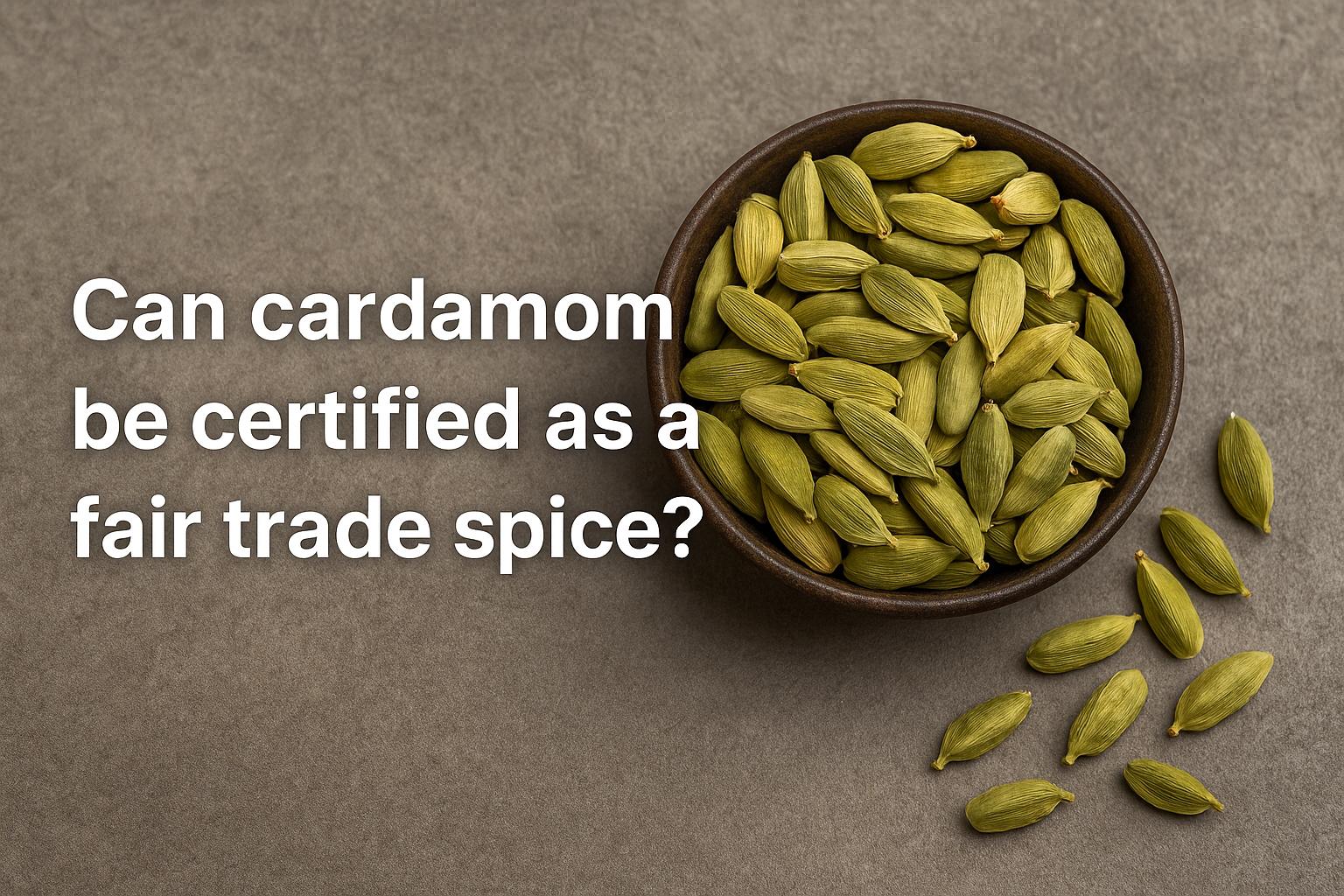
Can cardamom be certified as a fair trade spice?
Yes, cardamom can be certified as a fair trade spice when it meets ethical, environmental, and labor standards set by recognized organizations like Fairtrade International and Fair for Life. Certification requires traceable farming practices, safe working conditions, and fair pricing systems that support smallholder farmers and their communities. Once certified, cardamom becomes eligible for premium markets, minimum price guarantees, and social development funds, helping producers gain stability and global recognition in ethical trade.
What is the fair trade certification process for cardamom?
The fair trade certification process for cardamom involves a rigorous, multi-phase assessment of ethical, environmental, and trade practices by accredited certifiers.
- Application submission to an accredited certifier
Producer groups or exporters must first select a recognized certification body (e.g., FLO-CERT, Ecocert) and submit an application detailing their farming or processing practices. - Pre-audit documentation review and readiness checks
The certifier requests detailed documentation on production records, cooperative governance, labor contracts, chemical usage, environmental practices, and supply chain processes. - Initial on-site audit and farm visit by inspectors
Auditors visit the cardamom farms and processing facilities to verify working conditions, traceability systems, environmental compliance, and worker welfare in person. - Corrective actions and system improvements if required
If non-compliance issues are found, the applicant must address them through corrective action plans before final approval is granted. - Certification issuance and public registration
Upon successful audit and compliance, a certification is issued for 1–3 years, and the organization is listed in the public database of fair trade certified producers. - Annual follow-up audits and random spot checks
Continued compliance is ensured through mandatory surveillance audits. Surprise inspections may also be conducted to maintain accountability.
Which fair trade organizations certify cardamom globally?
Several global certification bodies offer fair trade verification specifically for spices, including cardamom. Each operates under its own standards but follows internationally recognized guidelines.
- Fairtrade International (FLO-CERT)
The leading global fair trade certifier, FLO-CERT certifies cardamom under its Small Producer Organization standard, emphasizing democratic governance, price fairness, and social premiums. - Fair for Life (by Ecocert)
A flexible certification system that allows for combined organic and fair trade certification, Fair for Life covers processors, handlers, and entire value chains including cardamom exporters. - FairWild Foundation
Specializing in sustainably harvested wild plants, FairWild certification is relevant for forest-grown cardamom, such as those found in Nepal’s Himalayan regions. - Naturland Fair (Germany)
Naturland Fair combines ecological farming with social responsibility. It is particularly active in European markets, certifying cardamom from organic cooperatives. - Small-scale national programs
In countries like India and Guatemala, regional fair trade alliances and local NGOs facilitate certification pathways by helping with documentation and audit preparation.
Are smallholder cardamom farmers eligible for fair trade certification?
Yes, smallholder farmers are often the intended beneficiaries of fair trade programs, and they qualify for certification under specific cooperative-based criteria.
- They qualify through Small Producer Organizations (SPOs)
Fairtrade International defines SPOs as legally registered cooperatives or associations of small-scale producers who democratically manage their group and profits. - Fair trade provides access to stable income
Smallholders benefit from minimum price guarantees and premium payments, reducing vulnerability to price crashes common in cardamom markets. - Cooperatives receive financial and technical training support
Certification programs often include funding for training in sustainable agriculture, pest control, record-keeping, and cooperative governance. - Group certification reduces cost burden
By certifying as a cooperative or collective, farmers share audit fees and administrative costs, making the process financially feasible for rural producers. - Certification helps with market entry and branding
Exporters and importers prefer certified cooperatives as it offers product traceability and brand trust, enabling smallholders to participate in high-value export trade.
What farming practices must be followed for fair trade cardamom?
Fair trade-certified cardamom farms must adhere to strict ethical and environmental standards that prioritize worker welfare, ecological health, and transparency.
- No child labor or forced labor allowed under any condition
Certification mandates zero tolerance for exploitative labor. Farmers must demonstrate that all work is voluntary and meets minimum legal working age requirements. - Safe and fair working conditions must be provided
Workers must be provided with personal protective equipment, breaks, fair wages, clean drinking water, and safe housing if living on-site. - Environmental conservation is required
Farmers must avoid deforestation, reduce soil degradation, and use sustainable water management techniques to prevent environmental harm. - Pesticide and chemical usage must follow strict limits
Use of banned pesticides is prohibited, and any agrochemical used must be properly documented, stored, and applied with safety protocols. - Biodiversity protection is encouraged
Farms are urged to grow cardamom under shade trees and in agroforestry systems, promoting soil stability and wildlife conservation. - Proper waste management systems must be in place
Wastewater from cardamom washing and drying must be treated or managed so it doesn’t pollute local water bodies or soil systems. - Farm record-keeping must be transparent and up-to-date
Farmers must keep logs of planting, inputs, labor, harvesting, and sales to allow for traceability and audit tracking.
Can exporters and processors of cardamom also be fair trade certified?
Yes, exporters and processors of cardamom can be fair trade certified if they follow the same ethical and traceability standards applied to producers.
- Fair trade certification applies to all supply chain actors
Certification is not limited to farmers. Exporters, packers, processors, and traders involved in handling or marketing fair trade cardamom must also be licensed under the relevant scheme. - Traceability from farm to export is mandatory
Certified exporters must maintain clear records tracing cardamom back to the certified producer groups. This includes harvest dates, batch IDs, processing logs, and buyer invoices. - Processors must comply with labor and hygiene standards
Facilities must demonstrate fair labor practices, clean and safe working conditions, and documentation of staff wages, contracts, and training programs. - Separate storage and labeling are required
Certified cardamom must be stored separately from non-certified stock to avoid cross-contamination. Proper labeling with fair trade ID codes is also mandatory during transport and export. - Exporters must pay fair prices and premiums
They are responsible for ensuring that farmers or cooperatives receive the correct minimum price and fair trade premium, which must be paid into a transparent development fund. - Annual audits are conducted to verify compliance
Exporters and processors are audited yearly or biannually by certification bodies, and non-compliance can result in suspension or revocation of certification.
What documentation is needed to apply for cardamom fair trade certification?
Accurate and complete documentation is essential for gaining and maintaining fair trade certification for cardamom at any level of the supply chain.
- Organizational legal documents
Applicants must submit cooperative registration certificates, business licenses, and legal ownership documents to prove legitimacy. - Production and harvest records
Detailed data on planting cycles, harvest quantities, drying methods, and sales must be submitted to verify production capacity and traceability. - Labor policies and employment contracts
Applicants must present written contracts, wage records, working hours, grievance procedures, and training logs to demonstrate labor law compliance. - Environmental impact reports or policies
Farmers or processors are required to document soil management, pesticide use, biodiversity conservation, and waste handling practices. - Internal Control System (ICS) manuals
Cooperatives must develop a structured system for monitoring member farms, which includes inspection reports, farmer training logs, and corrective action plans. - Premium fund usage plans
Producer groups must submit proposals or records showing how fair trade premiums will be or have been spent—such as on education, infrastructure, or health services. - Sales and financial transparency records
Exporters and cooperatives must maintain transparent financial documentation for all fair trade transactions, including invoices, bank receipts, and audit reports.
What are the main challenges in certifying cardamom as fair trade?
Certifying cardamom as a fair trade product can be highly beneficial, but several challenges make the process complex, especially for small-scale producers and new exporters.
- High cost of certification and audits
Certification fees, annual audits, and consultant services can be expensive, particularly for smallholder groups that may struggle to raise funds for initial setup. - Administrative burden and documentation complexity
Maintaining compliance requires ongoing documentation, accurate records, and systematic audits. Many producers lack the administrative capacity or literacy skills to meet these demands. - Limited awareness among growers and cooperatives
In many producing regions, farmers are unaware of what fair trade entails, how to apply, or what benefits it brings. This slows adoption and program scaling. - Market uncertainty despite certification
Certification does not guarantee market access. Certified producers may struggle to find committed buyers willing to pay fair trade premiums. - Difficulties in maintaining compliance
Changes in labor laws, environmental expectations, or certification criteria can create confusion or non-compliance risks for certified stakeholders. - Lack of local certifier presence in remote regions
In regions with weak infrastructure, delays in audits and limited access to trained consultants or auditors increase certification turnaround times.
What premiums or incentives are paid for fair trade cardamom?
Fair trade cardamom earns several economic and developmental incentives that support producers, workers, and communities directly involved in its cultivation.
- Guaranteed minimum price above market rate
Fair trade offers a floor price that cushions producers from volatile market fluctuations, ensuring they can cover basic production costs even when global prices fall. - Fair trade premium for community development
A fixed percentage (often 10–20%) is paid above the market price into a community fund, which is used to finance local education, healthcare, and infrastructure projects. - Access to long-term contracts with ethical buyers
Certified cardamom producers are more likely to be offered multi-season contracts by fair trade buyers who commit to ethical sourcing over time. - Training and capacity building support
Premium funds often go toward farmer training in organic farming, pest control, and post-harvest handling, improving both quality and yield. - Increased global visibility and branding value
Cardamom with fair trade labels can be positioned in premium markets and high-end retailers who prefer traceable, ethically sourced products. - Eligibility for donor funding or NGO partnerships
Certified groups can attract partnerships with international NGOs or development programs that offer infrastructure grants, irrigation systems, or business training.
How does fair trade certification impact cardamom pricing?
Fair trade certification affects cardamom pricing through structured pricing models, stable contract arrangements, and added value for buyers seeking ethical products.
- Minimum pricing structures reduce price volatility risks
Certified producers are protected from market crashes by a floor price that guarantees sustainable income even in low-price years. - Fair trade premiums create a dual pricing structure
Buyers pay an additional premium on top of the purchase price, which is not added to profit but directed to a community fund managed by the cooperative. - Ethical branding allows access to higher-value markets
Certified cardamom can be sold to brands and retailers willing to pay higher prices for traceable and socially responsible sourcing. - Improved product quality can command higher prices
Certification often leads to better farming practices and post-harvest processing, which results in higher quality cardamom suitable for premium markets. - Exporters can negotiate better deals with buyers
Having certification provides proof of compliance and sustainability, which strengthens a seller’s position in negotiations. - Stable pricing improves financial planning for producers
Knowing the minimum price and premium amount helps farmers and cooperatives plan investments and budget for seasonal expenses.
Does organic cardamom have a better chance of fair trade certification?
Yes, organic cardamom often has a higher chance of being fair trade certified due to the overlap between ecological sustainability and fair trade principles.
- Both systems emphasize environmental responsibility
Organic and fair trade certifications require sustainable farming practices, including soil health, water conservation, and elimination of synthetic pesticides. - Organic farms are often already aligned with fair trade standards
Organic farmers usually follow crop rotation, natural pest control, and composting methods, which meet the ecological criteria of fair trade systems. - Combined certifications are in high demand in export markets
Buyers in the EU, U.S., and Canada increasingly prefer products with dual certification—organic and fair trade—especially in gourmet and health-focused sectors. - Fair for Life and Naturland Fair encourage dual compliance
These bodies allow combined inspection processes, reducing audit duplication and helping organic cardamom producers streamline fair trade approval. - Access to higher premiums and price security
Organic fair trade cardamom fetches higher market prices and premium rates due to its value-added positioning in ethical and health-conscious niches. - Easier capacity-building support from NGOs and buyers
Development programs, buyers, and certification sponsors are more likely to invest in training and funding when producers aim for both certifications.
What are the social benefits of certifying cardamom as a fair trade spice?
Fair trade certification delivers direct social improvements to farming communities, creating long-term positive impacts beyond just economic gains.
- Improved working conditions and rights for laborers
Certification requires contracts, gender equality, proper rest periods, protective gear, and elimination of exploitative labor—upholding human dignity. - Education and school access in farming villages
Premium funds often finance school construction, provide school supplies, or fund scholarship programs for children of cardamom farmers and workers. - Community-owned healthcare and sanitation projects
Many certified groups allocate funds to build clinics, run medical camps, or install clean water systems, improving overall community health. - Strengthened local governance through cooperatives
Fair trade promotes democratic governance where all members vote on how premium funds are spent, fostering transparency and community participation. - Youth empowerment and gender equity
Programs support training and leadership roles for women and youth, making farming communities more inclusive and resilient. - Migration reduction through local opportunity
Fair prices and infrastructure investment reduce rural exodus by giving young people a reason to stay and thrive in farming communities.
How do buyers verify if cardamom is fairly traded?
Buyers verify fair trade cardamom through multiple traceability systems, certifications, and audit mechanisms provided by authorized certifiers.
- Checking the fair trade label on packaging
Products carry logos from Fairtrade International, Fair for Life, or other certifiers that guarantee the item was sourced under verified standards. - Requesting producer certification details
Buyers can ask suppliers or exporters for the certification license number, expiration date, and the name of the certification body for verification. - Using public certification databases
Most certifiers maintain searchable databases where buyers can confirm the status of a certified producer or exporter by entering their registration number. - Demanding full traceability documentation
Buyers may require batch codes, cooperative member lists, harvest records, and handling logs that trace the cardamom from farm to container. - Reviewing audit summaries or compliance reports
Some certifiers share basic compliance summaries or audit checklists with buyers under confidentiality agreements, enhancing trust and transparency.
Can fair trade cardamom improve traceability and supply chain transparency?
Yes, traceability and transparency are core requirements of fair trade systems and directly improve how cardamom is tracked and verified from farm to shelf.
- Batch tracking and digital records
Every batch of certified cardamom is labeled with a lot number tied to farmer groups, harvest dates, drying facilities, and packaging centers. - Chain-of-custody documentation
Each stage—harvesting, processing, transport, and export—is recorded and verifiable, allowing buyers to identify the exact journey of the product. - Mandatory segregation of certified and non-certified stock
Certified cardamom must be stored, labeled, and processed separately, reducing the risk of fraud or adulteration in supply chains. - Annual third-party verification audits
Certification bodies conduct yearly audits to confirm data accuracy, consistency, and compliance across every point in the value chain. - Improved communication between buyers and producers
Transparency systems encourage direct engagement between buyers and farming groups, leading to better understanding and long-term partnerships. - Compliance with EU and U.S. import transparency laws
Fair trade traceability systems help meet international legal standards such as the U.S. Customs-Trade Partnership and EU deforestation-free supply chain rules.
Are there any pilot programs for fair trade cardamom in producer countries?
Yes, several countries have launched or supported pilot projects to expand fair trade certification among cardamom farmers, especially smallholders.
- Guatemala has a well-established fair trade model
Indigenous farmer cooperatives in Alta Verapaz have successfully exported fair trade-certified cardamom to North America and Europe, setting a benchmark for others. - Nepal’s forest-based cardamom is gaining certification
NGOs and development partners are working with Himalayan farming communities to certify wild and agroforestry cardamom under FairWild and Fair for Life. - India’s tribal producer clusters show potential
Pilot programs in Kerala and Sikkim focus on converting tribal farmers to certified fair trade producers through training, organic transition, and cooperative formation. - Tanzania and Uganda exploring market entry
Development organizations are assessing feasibility and creating farmer networks for fair trade certification in East Africa’s growing cardamom sector. - Donor-funded traceability pilot systems
Digital tools and mobile apps are being tested to reduce certification costs and improve traceability compliance in remote rural areas. - Collaborations with ethical spice buyers
Some global spice brands co-finance these pilot projects by offering multi-year contracts to certified pilot groups, ensuring sustainability and market security.
Fair Trade Certification for Cardamom: Why It Matters
Fair Trade certification ensures farmers are paid ethically and farming practices are environmentally sound. Retailers increasingly seek fair-trade certified products. For transparent sourcing, buy fair-trade green cardamom for ethical distribution.
For unique smallholder supply chains, shop Thai cardamom from sustainable growers.
Conclusion
Cardamom can absolutely be certified as a fair trade spice when grown, handled, and exported according to strict social, environmental, and traceability standards. This certification helps farmers access better prices, build stronger communities, and meet the growing demand from ethical consumers around the world.
At ABIE Cardamon, we’re committed to sourcing only from fair trade-certified and organically aligned producers whenever possible. Our customers receive fully traceable, premium-quality cardamom with guaranteed freshness, ethical compliance, and sustainable value.
We offer overnight discreet delivery in the USA and Canada, 5 to 7-day shipping internationally, a 30-day full refund or replacement policy, and 100% customer satisfaction. All shipments include tracking numbers and discreet packaging for seamless, secure delivery.
If you’re ready to source cardamom the responsible way, ABIE Cardamon is your trusted global partner for ethical trade and top-tier spice quality.
Fair Trade Certification for Cardamom: Opening Ethical Markets
Fair trade certification allows cardamom producers to access buyers who prioritize sustainability, ethical sourcing, and community development. It ensures better pay, environmental practices, and long-term trade relationships. For social impact, explore How does cardamom support rural income generation? to understand its value to farming communities.
If you are working with cooperatives, see Are there cooperatives that process cardamom locally?—a key piece in meeting fair trade standards.
To reach new buyers, visit Is cardamom a profitable crop for export farming? and position your fair trade certification as a selling point.